
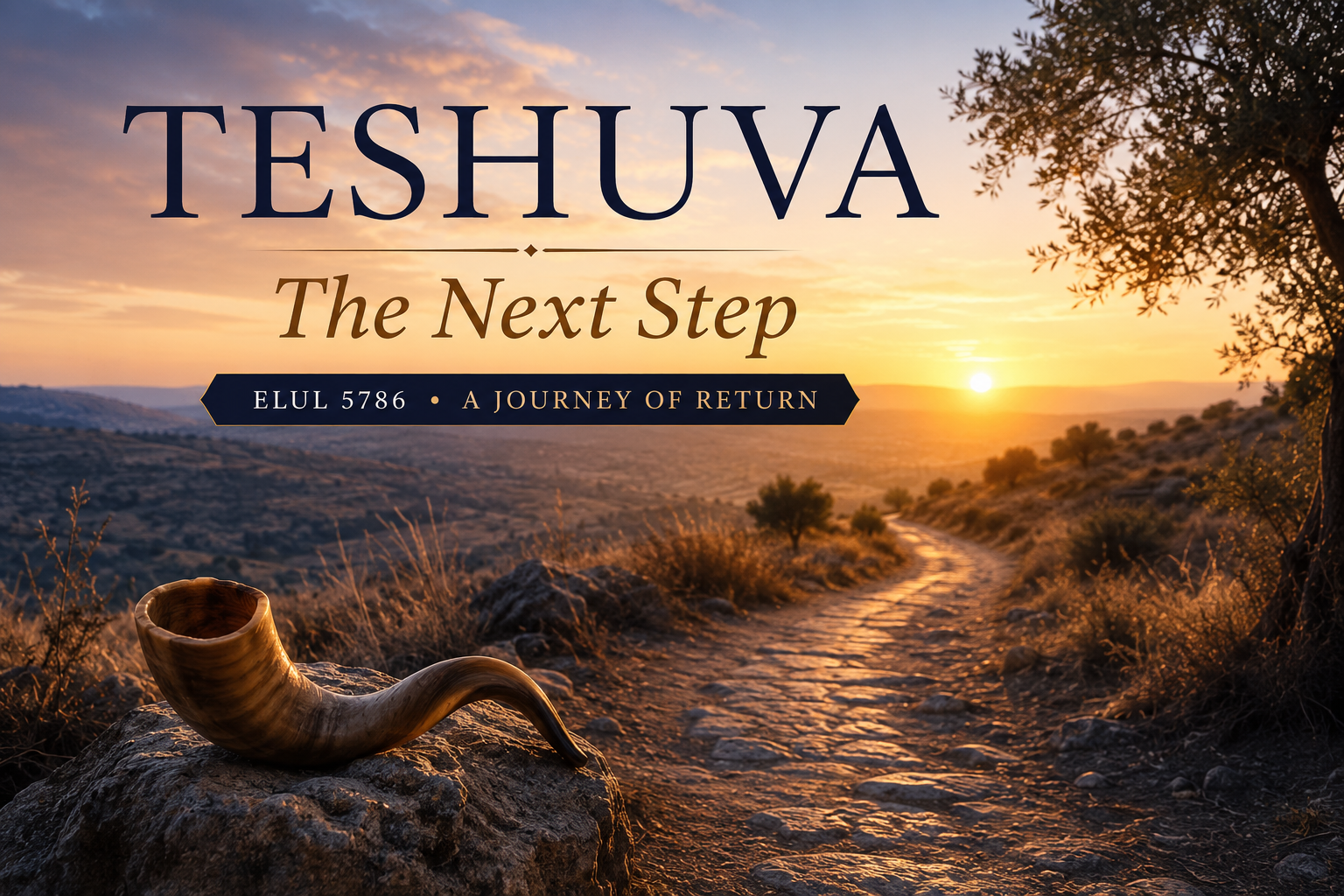
Teshuva: The Next Step
Tomorrow marks the beginning of the Hebrew month of Elul. That puts us one month out from the beginning of the fall holy days - Yom Teruah (Rosh HaShanah), Yom Kippur, and Sukkot (Tabernacles). In Jewish tradition, Elul is the signal to turn our attention Godward, because His appointed times, His moedim (Lev 23:1-4), are close now. One practical expression of that focus: through the whole month of Elul, in the tradition of synagogues, the shofar is sounded every day except Shabbat - a daily wake-up call to prepare to meet with God in the days ahead. In the coming weeks I will share more about this season on God's calendar. Consider this your invitation to begin preparing now, not later.
Last year we walked together through Teshuva For Beginners. We traced the word itself - return - from Moses on the mountain, through the prophets, through John the Baptist's cry in the wilderness, all the way to Yeshua's closing words to the seven assemblies of Revelation 2-3. We learned the shape of the season: forty days, Elul to Yom Kippur, patterned after the forty days Moses spent interceding after the golden calf fiasco (Ex 34:28; Dt 9:18).
If that was the map, this year we walk the road.
Everything we do in this season answers back to one sentence, the first one: "In the beginning God ..." (Ge 1:1). Before Sinai, before Egypt, before the fall in the garden, there was God's original intent for His creation - order out of chaos, life out of void, blessing poured into a world made very good. Every call to Teshuva, in every century, is an invitation to return to that intent. Teshuva is not primarily about fixing what is broken in us. It is about realigning with what God meant from the first sentence, and it is why the Word who "formed the stars and seas takes on flesh to restore all things" - the same God of Ge 1 is the God we meet walking the roads of the Galilee.
A Memorable Recap: Four Feasts, One Story
If you are joining us new this year, or if last year's details have faded (they do, that is what refreshers are for), here is the whole Fall Feast season in one breath:
The Trumpet Wakes - Yom Teruah, Day 30. The shofar sounds and heaven's books are opened for review.
The Days Warn - the ten Days of Awe between Trumpets and Atonement. The last window for turning before the verdict is fixed.
The Fast Seals - Yom Kippur, Day 40. Complete surrender, complete atonement, the books are sealed.
The Feast Rejoices - Sukkot, five days later. God moves into the neighborhood and dwells with His people in joy (Jn 1:14, "the Word became flesh and tabernacled among us").
Notice the arc: waking, warning, sealing, dwelling. That is not only Israel's autumn calendar. That is the whole gospel in miniature, and it is the shape of every genuine return to God.
It Went Without Saying, Until It Said It All
Here is something the original hearers of Scripture simply knew, and we usually have to be told. In the Ancient Near East, a trumpet blast was not primarily a musical event. It was the sound that announced a king had taken - or was about to take - his throne. Every reader in the first century heard the trumpet of Yom Teruah with royal enthronement already built into the sound, the way we hear sirens and immediately think "emergency," without anyone explaining it to us. That unstated assumption is exactly what Paul is drawing on when he writes that the Lord Himself will descend "with the trumpet of God" (1 Th 4:16) and that we will be changed "at the last trumpet" (1 Cor 15:52). He does not stop to explain the image because he does not have to - it went without saying. Once we recover that context, Yom Teruah stops being a quaint autumn custom and becomes what it always was: a rehearsal for the day the King takes His throne, tracing straight back to the first sentence's declaration that this world has always belonged to Him.
A Golden Fiasco
The forty days themselves exist because of a fiasco in the fullest sense. Israel's intent at the base of Sinai was to have a god they could see and control - something safe, something manageable, cast in gold (Ex 32:1-4). They got exactly what they intended. And it was a catastrophe; it shattered both the tablets and the relationship. Yet that same fiasco became the occasion for God to reveal Himself more fully than He ever had - "merciful and gracious, slow to anger, and abounding in steadfast love" (Ex 34:6) - and for the covenant to be renewed, not annulled. Creaturely intent ran its full course and produced the opposite of what it aimed for, and in the wreckage God's original design from Ge 1:1 - a world in relationship with its Maker - advanced further than before. Every Elul since has carried that pattern in its bones: our worst turning becomes the doorway to His clearest mercy, if we will actually turn.
The Next Level of Participation
Teshuva For Beginners was written mostly to be read. This year's journey is written to be walked, daily, together.
Starting this week, a short devotional will post to Facebook every day - seven days a week, forty-some days in all - each one small enough to read in a minute and sit with for the rest of the day. Every week, those seven days will also arrive in a single email, gathered with a short article like this one, so you have both the daily nudge and the weekly depth in hand.
This is the difference between hearing about return and practicing it. Teshuva For Beginners taught the pattern. This year we live inside it - personally, in our households, in our congregations, for our nation, and for Israel - one day, one honest prayer, at a time.
Rabbi Mark Fishman of Israel365 put the same widening arc into a single sentence this year while speaking to pastors across the country: "teshuva is a call to return to God, to take responsibility for the past, and to actively repair what has been broken." He went on to say it is "a message as urgent today as ever, not only on a personal level, but for nations and leaders seeking moral clarity in a turbulent world" (Israel365 News, 2026). Return, responsibility, repair - that is the whole of Teshuva in three words, and it is why this series will not stop at the personal. It follows the same road outward that Fishman names and that Ge 1:1 sets in motion: a Creator whose original intent was never only for individuals, but for a world.
Here is the road ahead, so you know what you are walking into. Beginning tomorrow, each week's article will widen the circle of who and what we bring before God, moving outward the way Scripture itself moves outward—from God's intent in the beginning, to the heart, to the house, to the assembly, to the nations, until at last we stand together before the King:
Week 1 — the road of return begins
Week 2 — the heart examined
Week 3 — the household healed
Week 4 — the assembly returned to her first love
Week 5 — Israel and the nations awakened by the trumpet
Week 6 — the people standing together before the King
For those keeping track of the calendar this year:
Yom Teruah begins at sundown September 11 and continues through September 12.
Yom Kippur begins at sundown September 20 and continues through September 21.
Sukkot begins at sundown September 25 and continues through September 26.
Between now and Yom Teruah, listen for that daily shofar blast of Elul. It is not yet the full trumpet announcing the King's enthronement—that sounds on Yom Teruah. It is the herald sounding ahead of the King, the way a town crier goes out before the procession arrives. Let every blast this month do its work in you.
Yeshua is still knocking (Rev 3:20). Last year we learned to recognize the sound. This year, let's open the door—together, daily, and in company with one another.
The journey begins tomorrow. Follow the devotionals daily on Facebook, and watch your inbox each week for the next article and the week's readings gathered in one place.
