
Reading John 7–9 through the festival, the prophets, and a First-Sentence Perspective
In the beginning God created the heavens and the earth.
That first sentence establishes whose world we inhabit. The earth belongs to God. So do the people who walk upon it. His instruction teaches us how to live in what He has made, and His work of redemption brings His creation back into fellowship with Him.
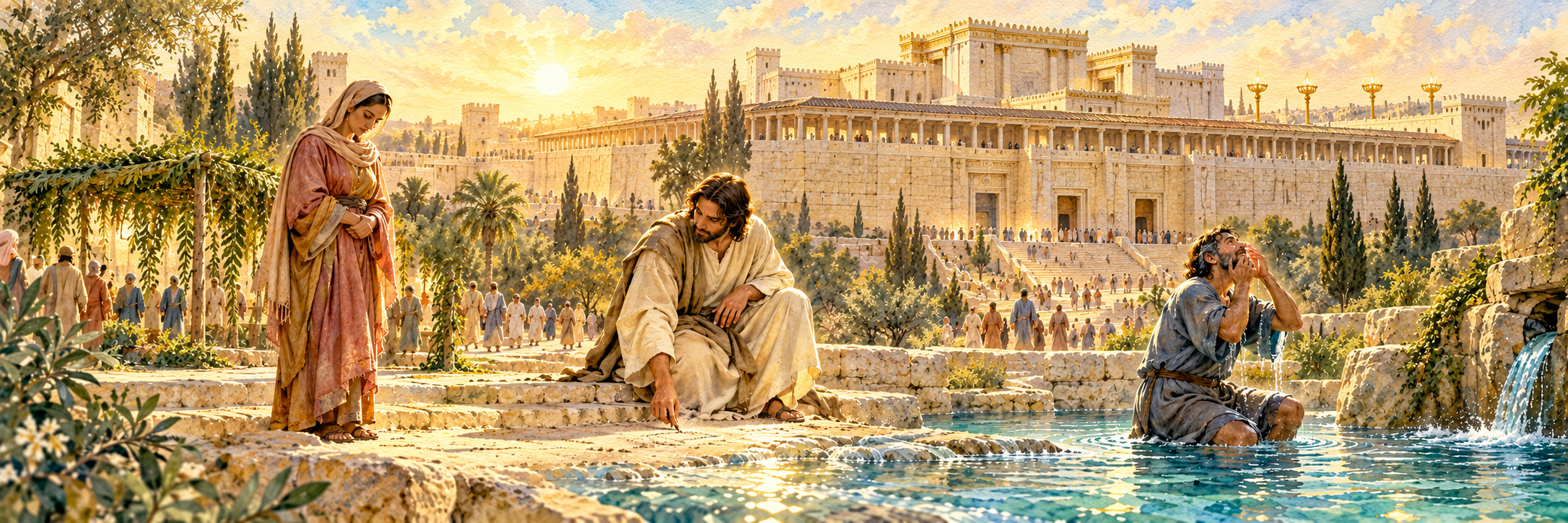
With that beginning in view, I want to return to Jerusalem and read John 7–9 as a connected movement. Yeshua—Jesus—is attending Sukkot, the Feast of Booths. He offers living water, declares Himself the light of the world, and gives sight to a man born blind. In the received text, a woman accused of adultery stands before Him as well.
These encounters invite us to consider what happens when the King comes among His people. How does He judge? How does He teach God's ways? What does the restoration of God's creation look like when it begins to take shape in an actual human life?
On Shemini Atzeret, the assembly that follows the seven days of Sukkot, those questions deserve our attention.
The festival already in the conversation
John gives us the setting plainly: the Feast of Booths is approaching, and Yeshua goes to Jerusalem (Jn 7:2, 10).
Leviticus 23:33–43 explains the feast. Israel gathers, rejoices, and lives in temporary shelters, remembering the wilderness journey after the exodus from Egypt. The harvest and the fragile booth both teach dependence upon the God who provides. After seven days comes an eighth-day sacred assembly: Shemini Atzeret (Lv 23:36, 39 Nu 29:35, Dt 16:18, 2Ch 7:8-9, Ne 8:18). It is closely connected with Sukkot, while distinguished from its seven days.
For those standing in Jerusalem, the festival was part of the conversation before Yeshua spoke. Its practices, memories, and scriptural associations could give His words a depth that a modern reader might miss.
Think of how much a familiar holiday can communicate without an explanation. Someone standing beside a Thanksgiving table does not need to define the meal before speaking about gratitude. The setting has already supplied part of the meaning.
Something similar may be happening here. We need not assume that every hearer understood every prophetic connection. Their disagreements show otherwise. But the feast supplied a shared world of meaning. John can name it and let that background do some of the work.
His Gospel repeatedly places Yeshua's ministry within God's sacred calendar: Passover, Sukkot, and the Feast of Dedication all appear. Here I read Yeshua as faithfully inhabiting the feast and bringing its promises into focus. The appointed time helps us recognize the One standing within it.
Living water and the reign of the King
On the last, great day of the feast, Yeshua calls the thirsty to come to Him and drink (Jn 7:37–39). John explains that He is speaking about the Spirit, whom believers will receive following His glorification.
Why speak about water here? At this time and place?
The Mishnah preserves an account of the Temple's Sukkot water ceremony. Water drawn from the pool of Siloam was carried to the Temple and poured as a libation. Although this collection was compiled after Yeshua's lifetime, its description of Temple practice supplies an important historical background. The water drawing is a likely context for His declaration, even though John does not narrate the ceremony itself.[1]
The prophets deepen that context. Ezekiel 47:1–12 pictures water flowing from God's sanctuary into a landscape that receives healing and life. Zechariah 14:7–9 brings together extraordinary light, living waters flowing from Jerusalem, and the Lord's kingship over the earth. Later in that same chapter, the surviving nations come to worship the King and celebrate Sukkot (Zec 14:16–19).
Water, light, kingship, and the feast belong together in that prophetic vision.
Those associations make Yeshua's invitation far more than a convenient illustration about thirst. At the feast that anticipates the worship of the King, He identifies Himself as the One to whom the thirsty should come. The life promised by the prophets is being announced in Jerusalem.
This is the eschatological dimension of the passage. That word refers to God's promised culmination of history. Here, something of that promised future becomes available within the present. John holds the timing carefully: the Spirit's gift awaits Yeshua's glorification. The invitation anticipates what His death, resurrection, and exaltation will make possible.
Righteous judgment in the Temple
Before the invitation to drink, Yeshua has already raised the question of how God's instruction should be understood.
In John 7:19–24, He reasons from the practice of circumcision on the Sabbath to His healing of a whole person. His argument asks His hearers to recognize God's purpose in the commandments. He concludes:
“Judge not according to the appearance, but judge righteous judgment.” — John 7:24, KJV
This is an important thread to carry into the next two chapters. The question is how people who appeal to Moses will discern and respond to the work of God before them.
Isaiah 11:1–5 describes the Spirit-endowed descendant of Jesse judging beyond surface appearances and establishing justice for the poor and vulnerable. Isaiah 2:2–4 pictures nations coming to Jerusalem to learn God's ways; instruction goes forth, judgment follows, and human life is reordered toward peace.
Those passages give substance to the image of the King making judgments. His authority establishes God's ways in the earth. In John, the Father has already entrusted judgment to the Son (Jn 5:22–30). The festival encounters allow us to watch that authority at work.
The woman and the writing in the earth
The account in John 7:53–8:11 has a complicated manuscript history. It is absent from the earliest surviving manuscripts of John and appears in different locations in some later witnesses. Most textual scholars regard its placement here as a later development.[2]
For this reading, I will take its placement as a deliberate interpretive expansion of the surrounding Sukkot themes. We cannot establish the inserter's intention, but we can explore what the story contributes in this location.
A woman is brought before Yeshua. Her accusers invoke Moses, while the narrator tells us that their purpose is to test Yeshua and obtain a charge against Him. He writes with His finger on the ground. When they persist, He challenges the person without sin to initiate the stoning. They leave. He releases the woman from condemnation and calls her to leave her sin behind.
Righteous judgment now concerns a person standing in the Temple. Mercy gives her a future in which obedience remains meaningful. The encounter also places the accusers' conduct under examination.
But why the writing on the ground?
Jeremiah 17:12–13 places sanctuary, judgment, and living water together. Those who abandon the Lord will be “written in the earth,” because they have forsaken “the fountain of living waters.”
Read that beside the invitation of John 7. Yeshua offers living water; soon afterward, in the received narrative, He writes in the earth while His opponents try to entrap Him. The action may echo Jeremiah's warning. Those bringing an accusation are themselves accountable to the God whose instruction they invoke.
The story does not disclose what Yeshua writes. We should leave that silence intact. Its possible prophetic significance does not require us to supply a list of names or sins.
Nor does His seated teaching posture prove that John is depicting a literal enthronement. Yet the scene can be read as royal judgment enacted among His people: authority expressed through truth, mercy, and a summons to a restored life.
The light gives sight
John 8:12 introduces Yeshua's declaration that He is the light of the world. Sukkot's Temple celebrations included large lamps in the Court of Women, remembered in the Mishnah for the light they cast over Jerusalem. This offers another likely festival resonance.[3]
John 9 then gives that declaration a human face.
As Yeshua passes by, He encounters a man born blind. The disciples ask whose sin caused his condition. Yeshua refuses their proposed explanation and directs attention toward God's work becoming visible in him. He repeats His identity as the world's light, makes clay, and sends the man to wash in Siloam (Jn 9:1–7).
That place name matters. The pool associated with the festival's water drawing becomes the place where the man receives sight. John also explains that Siloam means “Sent,” inviting us to hear an association with the One sent by the Father.
The promised light reaches a person's eyes. Water belongs to an act of restoration.
From a First-Sentence Perspective, the clay also deserves attention. Genesis 2:7 describes God forming humanity from the dust of the ground. John does not explicitly identify the clay as an allusion to that verse, but the resonance is suggestive: the Creator's restorative work reaches into the material of His own creation.
Placed together, the writing in the earth and the clay upon the man's eyes invite a theological reading. God's ways become visible in earthly encounters. A woman is called into a renewed life. A man receives sight. Divine instruction takes form in how people are treated and restored.
The judges come under judgment
The healing takes place on a Sabbath, and a dispute follows over whether Yeshua can be acting from God. As the man is questioned, the contrast between received sight and claimed understanding becomes sharper (Jn 9:13–34).
Eventually he is expelled. Yeshua finds him, and the encounter leads to faith and worship. Then comes the explicit statement about judgment:
“For judgment I am come into this world.” — John 9:39, KJV
Yeshua explains the reversal: those without sight receive it, while those who claim to see have their blindness exposed. The people examining the healing discover that their own discernment is being examined (Jn 9:35–41).
These are disputes within Israel's scriptural world, among people responding differently to Yeshua. They should also examine us. We can become so certain of our interpretation that we fail to recognize the person before us or the work God is doing.
Under the King's judgment, the ability to repeat an authoritative conclusion is insufficient. We must be willing to receive the light by which our conclusions are tested.
Learning the yoke of Yeshua
Torah means instruction. In the prophetic vision, God's instruction teaches people to walk in His ways and reshapes their life together.
Matthew 11:28–30 provides a fitting companion to John's narrative. Yeshua invites people to take His yoke and learn from Him. John does not use that expression here, but it helps name the discipleship these encounters call forth: placing ourselves under His authority and learning His way of obedience.
The King interprets God's instruction through His teaching and through His actions. He exposes the misuse of judgment, calls sin what it is, gives mercy, restores a human being, and makes the Father's work known.
If we speak of Torah being established in the earth, this is a concrete way to understand it. God's ways govern our judgments, our treatment of the vulnerable, and our response when His work challenges our assumptions.
His yoke asks us to become teachable enough to follow.
The eighth day and the world being restored
Does the woman encounter Yeshua on Shemini Atzeret? Possibly. If John's last, great day is Sukkot's seventh day, the next morning in John 8 would fall on the eighth-day assembly. If John 7:37 refers to the eighth day itself, the following morning would come afterward. The text does not settle the question, and John 9 does not independently identify its date.[4]
The festival's larger meaning remains available in either reading. As we observe Shemini Atzeret, the day beyond the seven-day feast can serve as a theological picture of the newness God promises. The Torah does not explicitly define it as a symbol of new creation; that connection arises from reading the festival within Scripture's larger story.
Revelation 21:1–5 pictures God dwelling with humanity and making all things new. Revelation 22:1–5 brings the river of life, the throne, and divine light together. Those visions describe a fulfillment still ahead. John 7–9 lets us consider its beginnings in Yeshua's ministry.
I hear these chapters as a glimpse of the coming King's rule. He announces the water of life. He brings hidden motives into the light. He gives sight. His judgments call people out of sin and false certainty, and into restored fellowship with God.
On this Shemini Atzeret, I want you to ask: am I willing to be taught by that King. Can I receive His mercy without defending my sin? Can I recognize His work when it unsettles my conclusions? Can His instruction become visible in the way I treat the people who belong to Him?
The first sentence still establishes the horizon: God created this world. Its restoration belongs to His purpose.
And in these encounters, we begin to see what life under His reign looks like.
Read alongside the article
Begin with John 7–9, paying particular attention to 7:19–24, 7:37–39, 8:1–12, 9:1–7, and 9:35–41. Then read Leviticus 23:33–43, Zechariah 14, Jeremiah 17:12–13, Isaiah 2:1–4, and Isaiah 11:1–5.
For the wider creation and restoration horizon, read Genesis 1–2, Ezekiel 47:1–12, Matthew 11:28–30, and Revelation 21:1–5 and 22:1–5.
Historical and textual notes
Mishnah Sukkah 4:1 and 4:9 describes the seven-day water libation and the drawing of water from Siloam. The Mishnah was compiled around the beginning of the third century CE; its Temple traditions are valuable evidence, while the precise first-century setting of Yeshua's declaration remains a reconstruction.
The NET Bible textual note on John 7:53 discusses the passage's absence from early manuscripts, its varying locations, and its thematic fit here. This article adopts an interpretive purpose for its placement as a working hypothesis, not a documented historical conclusion.
Mishnah Sukkah 5:2–4 describes the lamps and celebration. John does not say the lamps were burning when Yeshua spoke; the connection concerns the festival imagery.
The NET Bible note on John 7:37 explains the seventh-versus-eighth-day question. Shemini Atzeret in 2026 begins at sundown October 2 and concludes at nightfall October 3; see Hebcal.
This reflection continues the creation and restoration perspective introduced in In the Beginning and the festival discussion in Sukkot When the King Comes to Dwell With Us.
