
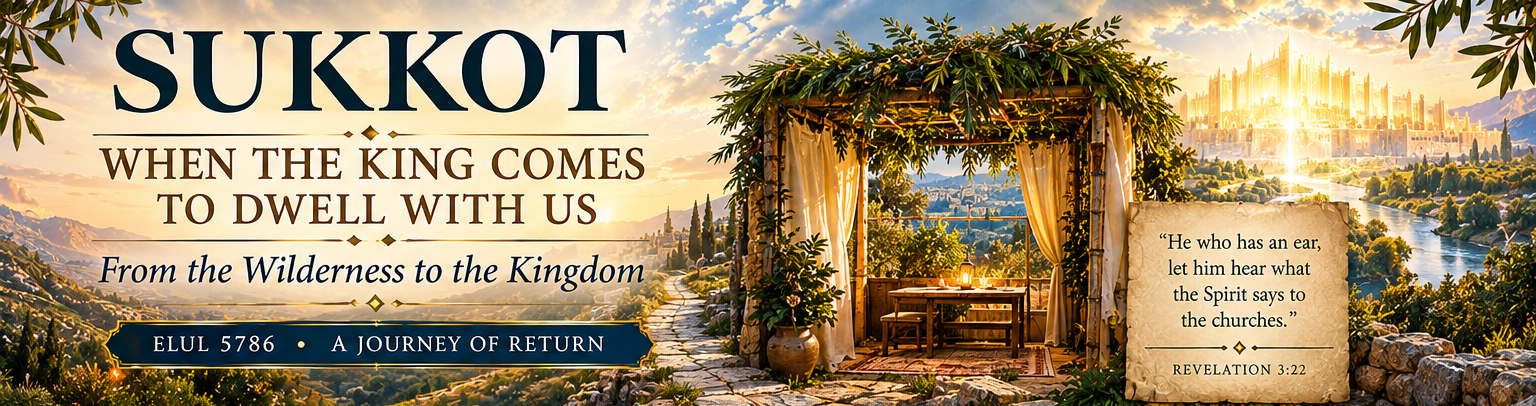
From Yom Kippur to the Feast of His Presence
The journey of Teshuva does not end with Yom Kippur.
In fact, Yom Kippur points us somewhere.
It points beyond repentance, beyond confession, beyond judgment, and beyond atonement—to the presence of the King.
That is where Sukkot takes us.
The biblical calendar moves from Yom Teruah, the sounding of the trumpet, to Yom Kippur, the Day of Atonement, and then to Sukkot, the Feast of Booths.
The progression is remarkable:
The trumpet sounds. The people return. The King judges. Atonement is made. Then God dwells with His people.
And that last movement is where the story has been heading from the beginning.
“In the beginning God created the heavens and the earth.” (Ge 1:1)
God creates a dwelling place.
He creates humanity in His image.
He places them in Eden.
He desires to dwell with His image-bearers.
Sin disrupts the dwelling.
Redemption begins the restoration.
And Sukkot gives us a picture of where the story is ultimately going: God dwelling with His people under the reign of the King.
Sukkot: Remembering When God Dwelt With His People
Leviticus 23 gives the basic command.
Sukkot begins on the fifteenth day of the seventh month and lasts seven days. The people are to rejoice before the LORD, live in temporary booths, and remember why:
“So that your generations may know that I had the sons of Israel live in booths when I brought them out from the land of Egypt.” — Lev 23:43
The sukkah is therefore more than a harvest decoration.
It is a memorial.
Israel was brought out of Egypt, but Egypt was not the destination.
God was bringing His people to Himself.
He brought them into the wilderness, where they lived in temporary dwellings and where He dwelt in their midst.
The wilderness was not merely the place between Egypt and the Promised Land.
It was the place where Israel learned what it meant to live with God.
The cloud.
The fire.
The tabernacle.
The glory.
The presence.
God had redeemed them so that He could dwell among them.
Exodus 25:8 gives the purpose of the tabernacle:
“Let them construct a sanctuary for Me, that I may dwell among them.”
That is the great movement of the biblical story.
God does not merely rescue people from something.
He brings them to Himself.
The Temporary Dwelling Points to the Permanent One
There is something wonderfully temporary about the sukkah.
It is fragile.
It is exposed.
It is not a permanent house.
It reminds Israel that the wilderness generation lived in temporary dwellings because God was leading them somewhere.
But there is another layer.
The temporary dwelling points toward the permanent dwelling.
John begins his Gospel with language that sounds remarkably like the language of Sukkot:
“And the Word became flesh, and dwelt among us.” (Jn 1:14)
The Greek verb translated “dwelt” is eskēnōsen—literally, “tabernacled” or “pitched His tent.”
The One who dwelt in the wilderness tabernacle now comes in human flesh.
The presence of God is no longer merely associated with a tent made by human hands.
The Word becomes flesh.
God comes near.
Yeshua is not simply another messenger telling us about God's presence.
He is Emmanuel—God with us.
Sukkot therefore becomes a powerful picture of the Messiah.
The God who once dwelt among Israel in the wilderness comes among His people in Yeshua.
But even that is not the end.
Because Scripture still points forward to a day when God's dwelling with humanity will be fully realized.
“Behold, the tabernacle of God is among people, and He will dwell among them.” — Rev 21:3
Sukkot points backward to the wilderness.
It points to Yeshua.
And it points forward to the day when God's dwelling with humanity is no longer temporary.
From Yom Kippur to Sukkot: From Judgment to Dwelling
This is why the relationship between Yom Kippur and Sukkot matters.
Yom Kippur confronts sin.
Sukkot celebrates dwelling.
We might say: Yom Kippur answers the question, “How can sinful people approach a holy God?”
Sukkot answers the next question: “What is God's purpose once His people have been reconciled to Him?”
The answer is: He dwells with them.
The Day of Atonement comes first.
Then comes the Feast of Booths.
There is a beautiful theological movement here:
Atonement makes fellowship possible. Fellowship makes dwelling possible. Dwelling leads to joy.
This is why Sukkot is called “the season of our joy” in Jewish tradition.
Leviticus repeatedly emphasizes rejoicing:
“You shall rejoice before the LORD your God for seven days.” (Lev 23:40)
The joy is not superficial happiness.
It is the joy of a people who have been brought through judgment, forgiven, gathered, protected, provided for, and brought into the presence of their King.
Seven Days—and Then an Eighth
The Torah gives Sukkot a fascinating structure.
There are seven days of the Feast of Booths.
Then comes an eighth day.
Leviticus says:
“For seven days you shall present an offering by fire to the LORD. On the eighth day you shall have a holy convocation...” — Lev 23:36
Numbers 29 gives the same pattern. Seven days of Sukkot are followed by:
“On the eighth day you shall have a solemn assembly.” — Nu 29:35
The eighth day is called Shemini Atzeret, literally, the “eighth-day assembly.”
It is related to Sukkot but is also distinguished from the seven-day feast in the Torah itself. The later celebration called Simchat Torah, “Rejoicing in Torah,” developed much later and became associated with Shemini Atzeret; in Israel and many communities today, the two are celebrated together.
That distinction is important.
We should not read the medieval development of Simchat Torah back into Leviticus as though Moses gave Israel a holiday by that name.
But the eighth day is biblical.
And the later Jewish celebration of rejoicing in Torah gives us a remarkable way to appreciate the significance of the eighth day.
The seven-day feast reaches its conclusion.
And then there is one more day.
An added day.
A day of assembly.
A day that stands beyond the seven.
That makes the eighth day a fascinating biblical image of completion—and something beyond completion.
The Eighth Day: The Season of Our Joy
Sukkot is already the great feast of rejoicing.
But the eighth day carries the celebration beyond the seven-day cycle.
The later Jewish tradition of Simchat Torah gives this day a particular expression: rejoicing in God's Torah. The annual reading cycle reaches Deuteronomy, concludes it, and immediately begins again with Genesis. The Torah is not finished in the sense of being left behind.
The ending becomes a beginning.
That is a beautiful image for the biblical story.
Creation.
Fall.
Redemption.
Restoration.
Completion.
And then—new creation.
The eighth day becomes a fitting picture of what Scripture repeatedly describes as the world beyond the present order.
The eighth day is not merely: “Day seven plus one.”
It can be seen as the day that points beyond the completed cycle into something new.
This is one reason the number eight has acquired such rich symbolic associations in Jewish and Christian interpretation.
But we should let Scripture establish the foundation before symbolism takes over.
The eighth day is first of all what the Torah says it is: a sacred assembly.
And then John gives us something extraordinary.
Yeshua and the Last and Greatest Day
John 7 places Yeshua at Jerusalem during the Feast of Booths.
John tells us:
“Now on the last day, the great day of the feast, Yeshua stood and cried out, saying, ‘If anyone is thirsty, let him come to Me and drink.’” — Jn 7:37
Then:
“He who believes in Me, as the Scripture said, ‘From his innermost being will flow rivers of living water.’” — Jn 7:38
And John immediately explains:
“But this He said in reference to the Spirit...” — Jn 7:39
The phrase “the last day, the great day” is extraordinarily significant.
There is a question of chronology here that deserves honesty. Some interpreters understand John's “last and greatest day” as the seventh day of Sukkot; others understand it as the eighth-day assembly, Shemini Atzeret. The Torah itself distinguishes the seven-day Feast from the eighth-day sacred assembly, and John does not explicitly name the eighth day.
But there is a strong reason to see an eighth-day connection.
John deliberately places Yeshua's declaration at the climactic conclusion of the feast. And what does He announce?
Living water.
That is precisely where the prophetic trajectory of Sukkot leads.
Why Water?
Water is not an accidental image in this setting.
Sukkot occurs at the beginning of Israel's rainy season. Later Jewish practice associated Sukkot with a water-pouring ceremony in the Temple, connected with prayers for rain. The Mishnah records this ceremony, although it is important to recognize that the Torah itself does not prescribe the water libation. It was a later Temple practice.
So when Yeshua stands in the Temple during Sukkot and cries: “If anyone is thirsty, let him come to Me and drink,”
His words resonate with the imagery surrounding the feast:
Rain.
Water.
Harvest.
Life.
Temple.
God's provision.
And the prophetic hope of living water flowing from Jerusalem.
John himself tells us that Yeshua was speaking about the Spirit.
So the meaning is not merely: “Jesus gives people emotional refreshment.”
It is much larger.
The life-giving presence of God is coming through the Messiah.
The Spirit is the living-water reality.
From the Wilderness Rock to the Temple River
The biblical story of water has been building for a long time.
In the wilderness, God provides water from the rock (Ex 17:1–7; Nu 20:1–13).
Paul later identifies that wilderness provision with Messiah:
“They were drinking from a spiritual rock which followed them; and the rock was Christ.” — 1 Co 10:4
Then the prophets begin looking forward to something even greater.
Isaiah says:
“You will joyously draw water from the springs of salvation.” — Isa 12:3
Joel describes a coming day when:
“A spring will go out from the house of the LORD.” — Joel 3:18
Ezekiel sees water flowing from the Temple, beginning as a trickle and becoming a river that brings life wherever it goes (Eze 47:1–12).
And Zechariah gives us an extraordinary combination of living water and the reign of the King:
“On that day living water will flow out from Jerusalem...” (Zec 14:8)
Then immediately:
“And the LORD will be King over all the earth.” (Zec 14:9)
And what happens next?
The nations come to Jerusalem to worship the King and celebrate Sukkot.
“Then the survivors from all the nations... will go up year after year to worship the King, the LORD of armies, and to celebrate the Festival of Tabernacles.” (Zec 14:16)
Now the connection becomes difficult to miss.
Sukkot is not merely about remembering the wilderness.
It looks forward to the reign of the King.
And under the King's reign: living water flows from Jerusalem.
The King Who Judges Becomes the King Who Dwells
This brings us back to Yom Kippur.
Our Teshuva journey has just taken us through the language of judgment.
The King comes.
He examines.
He calls His people to account.
He provides atonement.
And then Sukkot opens another dimension: The Judge is the King who dwells with His people.
Zechariah 14 is especially important because it puts these themes together.
The LORD becomes King over all the earth.
Jerusalem is established.
Living water flows from Jerusalem.
The nations come to worship.
And the nations come to keep Sukkot.
That is not simply a picture of private spirituality.
It is a picture of the Kingdom of God filling the earth.
The King reigns.
His presence is established.
The nations acknowledge His rule.
And the feast of Sukkot becomes a recurring memorial of His reign.
Torah Goes Forth From Jerusalem
Isaiah gives us another piece of the picture.
“In the last days the mountain of the house of the LORD will be established... and all the nations will stream to it.”
And why will they come?
“He will teach us His ways so that we may walk in His paths.”
Then comes the remarkable statement:
“For the law (Torah) will go out from Zion, and the word of the LORD from Jerusalem.” — Isa 2:2–3
Micah says virtually the same thing (Mic 4:1–2).
This is not merely a picture of people receiving information.
It is a picture of the nations learning the King's ways.
The King reigns.
The nations come.
The Torah goes forth.
The nations learn His ways.
And the result is peace:
“Nation will not lift up sword against nation, and never again will they learn war.” (Isa 2:4)
This fits beautifully with the Teshuva journey we have just completed.
Teshuva is not merely turning away from sin.
It is returning to God's ways.
And the prophetic picture of the Kingdom is a world learning those ways from the King.
“If Anyone Is Thirsty...”
Now return to Yeshua's words in John 7.
“If anyone is thirsty, let him come to Me and drink.”
Notice the invitation.
Anyone.
This is already the nations.
This is the fulfillment of the promise to Abraham beginning to unfold. (Ge 12:2-3)
The water is not restricted to one ethnic group.
The Messiah stands in Jerusalem and announces that whoever thirsts may come.
And what happens to the one who comes?
The water does not merely remain inside him.
It flows from him.
“He who believes in Me... from his innermost being will flow rivers of living water.” (Jn 7:38)
John says plainly that Yeshua was speaking about the Spirit (Jn 7:39).
But the prophetic imagery reaches further.
The Spirit is not merely an inward religious experience.
The Spirit becomes the life of God flowing outward.
That is exactly what Ezekiel sees.
Water comes from the sanctuary.
It flows outward.
And everywhere the river goes, life appears.
The River Beneath the Throne
Here we need to make one important distinction.
Ezekiel 47 describes water flowing from the Temple, beginning beneath its threshold.
Revelation 22 describes the river of the water of life flowing from the throne of God and of the Lamb.
Revelation 22 is associated with the new creation, not specifically the thousand-year reign of Revelation 20.
But Ezekiel's temple river is often understood in Christian interpretation as part of the prophetic picture of the Messianic Kingdom, while Revelation brings the imagery to its ultimate fulfillment in the eternal dwelling of God with humanity.
The two passages should therefore not simply be collapsed into one.
Yet the imagery is breathtakingly connected.
Ezekiel sees water flowing from God's dwelling place.
Zechariah sees living water flowing from Jerusalem when the LORD (YHVH) is King.
John hears Yeshua announce living water at the climax of Sukkot.
And Revelation finally sees:
“A river of the water of life, clear as crystal, coming from the throne of God and of the Lamb.” — Rev 22:1
The movement is unmistakable: God's presence → living water → life flowing outward.
The source is always God.
The Thirst of the Nations
There is another dimension to Yeshua's statement that deserves our attention.
He does not say: “If anyone is curious...”
He says: “If anyone is thirsty.”
Thirst is need.
Thirst is recognition that we cannot manufacture what we require.
The wilderness taught Israel this lesson.
They could not create water.
They had to receive it.
The nations will learn the same lesson in the prophetic kingdom.
Zechariah specifically connects Sukkot with rain. Nations that refuse to come to worship the King experience the withholding of rain (Zec 14:17–19).
The message is powerful:
Life comes from the King.
Water comes from the King.
Provision comes from the King.
The nations cannot sustain themselves independently of Him.
And that is exactly what Teshuva teaches.
Repentance is the abandonment of self-rule.
“I can provide for myself.”
“I know what is best.”
“I will determine my own way.”
Teshuva says:
No.
There is a King.
And from the King comes life.
Sukkot and the Nations
This is perhaps one of the most remarkable features of Sukkot's prophetic horizon.
Passover remembers Israel's deliverance.
Shavuot remembers covenant and provision of Torah.
Yom Teruah announces the King.
Yom Kippur confronts sin and atonement.
And Sukkot opens outward toward the nations worshiping the King.
Zechariah 14 is explicit.
The nations come to Jerusalem.
They come to worship the King.
They come to celebrate Sukkot.
And Jerusalem becomes associated with living water and the reign of God.
That means Sukkot belongs naturally at the end of our Teshuva of the Nations journey.
We have moved:
From the individual to the heart to the household to the assembly to the nations to the King.
And now we discover what the King desires: to dwell with His people.
The Eighth Day and the Joy That Continues
Then comes the eighth day.
The seven days have been completed.
The harvest has been gathered.
The people have rejoiced.
The booths have reminded them of the wilderness.
The King has been worshiped.
And then—one more day.
Shemini Atzeret.
An assembly beyond the seven.
Later, Simchat Torah becomes associated with this day as the celebration of the Torah itself—the completion of one annual reading cycle immediately followed by the beginning of another.
There is something profoundly appropriate about that.
The Torah ends.
And then Genesis begins:
“In the beginning...”
The story starts again.
The ending becomes a beginning.
And perhaps this is one of the most beautiful ways to understand the biblical rhythm of the eighth day.
The seven-day cycle reaches completion.
But God is not finished.
There is more.
The King does not simply bring us to the end.
He brings us into newness.
The Last and Greatest Day
This gives additional weight to John's wording.
If John's “last and greatest day” refers to the eighth-day assembly—as the chronology can reasonably allow—then Yeshua's declaration becomes almost startlingly appropriate.
On the day that stands beyond the seven-day feast, the Messiah cries out: “If anyone is thirsty, let him come to Me and drink.”
The seventh-day feast has reached its conclusion.
The eighth day opens.
And Yeshua announces living water.
John then tells us that this water is the Spirit.
The Spirit is the foretaste of the age to come.
The presence of the future enters the present.
The King has not yet established His kingdom in its fullness, but the life of that coming Kingdom has already begun to flow.
This is why Yeshua can make such a remarkable claim.
The future river is already present in seed form.
The future dwelling is already being experienced.
The future Kingdom is already breaking into the present.
And the people of God become the place from which that life flows.
From Sukkot to the New Creation
The final picture in Scripture is astonishing.
Revelation 21 says:
“Behold, the tabernacle of God is among people, and He will dwell among them.” (Rev 21:3)
Then Revelation 22 shows the river:
“The river of the water of life, clear as crystal, coming from the throne of God and of the Lamb.” (Rev 22:1)
And beside the river is the tree of life.
The curse is gone.
God's servants serve Him.
They see His face.
And then comes the final invitation:
“The Spirit and the bride say, ‘Come.’ And the one who hears is to say, ‘Come.’ And the one who is thirsty is to come; the one who wishes is to take the water of life without cost.” — Rev 22:17
Do you hear the echo?
John 7:
“If anyone is thirsty, let him come to Me and drink.”
Revelation 22:
“The one who is thirsty is to come.”
The invitation of Sukkot reaches all the way to the final pages of Scripture.
Sukkot: God Wants His Creation Back
And perhaps this brings us back to where our entire Teshuva journey began.
In the beginning God...
God created.
God dwelt.
Humanity rebelled.
God pursued.
God redeemed.
God made covenant.
God tabernacled among Israel.
God came among us in Yeshua.
Yeshua gave the Spirit.
The King will reign.
The nations will come.
Living water will flow.
And finally: God will dwell with humanity.
The temporary sukkah points toward the permanent dwelling.
The wilderness points toward the Kingdom.
The water from the rock points toward the river.
The Feast points toward the King.
And the King points toward the day when God's presence fills His creation.
This is why Sukkot is a feast of joy.
Not because everything is already finished.
But because we know where the story is going.
The King is coming.
The King will reign.
The King will dwell with His people.
The nations will come.
The Torah will go forth from Jerusalem.
Living water will flow.
And the invitation will still be: Come.
The Season of Our Joy
We began this journey of Teshuva with a question: “Where are you?”
We searched the heart.
We entered the house.
We listened to the Spirit speaking to the ekklesia.
We heard the trumpet calling the nations.
We stood before the King on Yom Kippur.
And now Sukkot answers with joy: He wants to dwell with us.
That is the destination of repentance.
Not endless sorrow.
Not perpetual self-examination.
Not religious performance.
Presence.
The King has made a way for us to come near.
And the eighth day reminds us that even when the cycle seems complete, there is still something beyond it.
A greater day.
A greater dwelling.
A greater joy.
A greater river.
A greater Kingdom.
And finally, the greatest promise of all:
“Behold, the tabernacle of God is among people, and He will dwell among them.” — Rev 21:3
So let us rejoice.
The King is coming.
And He is coming to dwell with us.
Key Scripture Trail
For readers who want to follow the thread themselves:
Sukkot and the wilderness: Lev 23:33–43; Ex 25:8; Ex 29:45–46; Nu 29:12–38
The eighth day: Lev 23:36, 39; Nu 29:35–38
The King and Sukkot: Zec 14:8–9, 16–21
Living water: Isa 12:3; Isa 44:3; Eze 47:1–12; Joel 3:18; Zec 14:8
Torah from Jerusalem: Isa 2:2–4; Mic 4:1–4
Yeshua and Sukkot: Jn 7:2, 37–39
The Spirit as living water: Jn 4:10–14; Jn 7:37–39
The final dwelling: Rev 21:1–4; Rev 22:1–5, 17
The final invitation: Rev 22:17
