
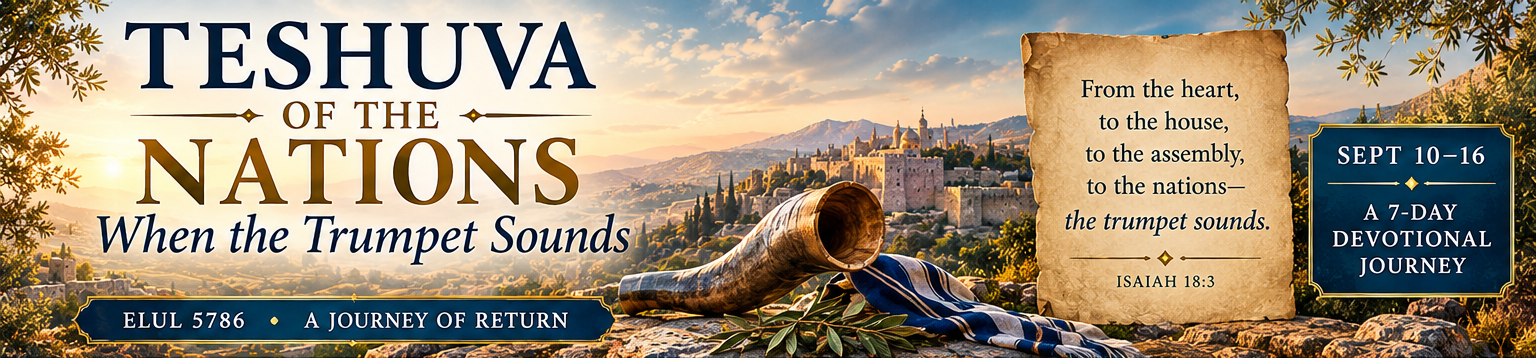
Teshuva of the Nations: When the Trumpet Sounds
For four weeks, the circle has been widening.
We began with the individual:
“Where are you?” (Ge 3:9)
Then we entered the inner rooms of the heart:
“Search me, O God.” (Ps 139:23)
We crossed the threshold into our homes and closest relationships:
“What is mine?”
Then we gathered with the ekklesia, the assembly of Yeshua, and listened to what the Spirit says to the churches.
We have examined first love, faithfulness, compromise, truth, reputation, weakness, and prosperity. We have learned that Teshuva is not merely an individual exercise. It is also a corporate responsibility.
Now the circle widens again.
From the heart, to the house, to the assembly—and now to the nations.
The trumpet sounds.
The Sound That Calls Us Beyond Ourselves
The biblical story has never been confined to one individual, one household, or one congregation.
God called Abraham and promised:
“In you all the families of the earth shall be blessed.” (Ge 12:3)
Israel was chosen, not as an end in itself, but as a people through whom the blessing of God would reach the nations.
God declared:
“You shall be to Me a kingdom of priests and a holy nation.” (Ex 19:6)
A priest stands before God on behalf of others. Israel’s calling included bearing witness to the holiness, mercy, justice, and faithfulness of the God who had made covenant with them.
This does not erase Israel’s particular calling or replace it with the nations. Instead, it reveals the expansive purpose of God: to bring blessing to all the families of the earth.
The prophets repeatedly looked forward to the nations turning toward the God of Israel.
“Turn to Me and be saved, all the ends of the earth!” (Isa 45:22)
“All the nations shall flow to it.” (Isa 2:2)
“My house shall be called a house of prayer for all peoples.” (Isa 56:7)
The trumpet of Teshuva is therefore not a call for one people to congratulate themselves while judging everyone else.
It is a summons for all peoples to turn toward the living God.
The Nations Are Not Outside the Story
The word nations translates the Hebrew goyim and the Greek ethnē. Depending on the context, it can refer to peoples, ethnic communities, or nations outside Israel.
Scripture does not present the nations as spiritually irrelevant. From the beginning, they are included in God's purposes.
The promise to Abraham reaches beyond his immediate family. The prophets anticipate worship that extends beyond Jerusalem. Yeshua commands His disciples to make disciples of all nations (Mt 28:18–20). Revelation culminates in a multitude:
“From every nation, from all tribes and peoples and languages.” (Rev 7:9)
The nations are not an afterthought.
They are part of the horizon of redemption.
Yet the call to the nations is not simply an invitation to receive blessing. It is also a call to repentance, allegiance, justice, and worship.
The same God who calls Israel to covenant faithfulness calls the nations to turn from idols and acknowledge His rule.
Paul announced in Athens:
“God commands all people everywhere to repent.” (Ac 17:30)
Not some people.
Not merely the obviously immoral.
Not only those outside our religious communities.
All people everywhere.
That includes us.
When the Trumpet Sounds
The shofar carries several overlapping biblical meanings.
It announces danger (Joel 2:1).
It gathers the people (Lev 23:24).
It marks appointed times (Lev 23:4).
It announces liberty in the Year of Jubilee (Lev 25:9–10).
It calls the people to attention before God.
The sound does not create the need for response. It reveals that the time to respond has come.
A trumpet can be heard without being obeyed.
A warning can be recognized without being received.
A summons can be discussed without anyone moving.
That is one of the dangers of religious familiarity. We can become skilled at recognizing sacred language while remaining resistant to its demand.
Yeshua repeatedly says:
“He who has an ear, let him hear what the Spirit says.” (Rev 2–3)
Hearing in Scripture is more than receiving information. It carries the expectation of response.
The question is not simply:
Have we heard the sound?
The question is:
What will we do because we have heard it?
Yom Teruah: A Holy Convocation
Leviticus 23:23–25 describes the first day of the seventh month as a day of solemn rest and a memorial proclaimed with blasts.
It is a holy convocation.
The day is commonly called Yom Teruah, the Day of Shouting or Trumpet Blasts.
The text does not provide every later interpretation associated with the day. It does, however, establish a pattern:
A set time.
A sacred gathering.
A trumpet proclamation.
A call to attention before God.
The shofar interrupts ordinary life.
It reminds us that time belongs to God, that worship cannot be reduced to convenience, and that the people of God are summoned into His presence.
As we hear the trumpet imagery of Yom Teruah, we should not treat it merely as an interesting prophetic symbol. We should allow it to ask us whether we have become inattentive to the voice of God.
Where have we become spiritually distracted?
Where have we heard God's call but delayed obedience?
Where have we assumed that because we belong to a believing community, we no longer need to respond personally?
The trumpet sounds, and the people are called to gather.
Repentance Is Not Tribal
There is a particular temptation when Teshuva turns toward the nations.
We may begin to speak about their idolatry, their injustice, their violence, their corruption, or their rejection of God.
Sometimes these concerns are real. Scripture does not ignore the sins of nations or rulers.
But the biblical prophets did not speak as detached observers who believed themselves exempt from judgment.
Daniel prayed:
“We have sinned and done wrong and acted wickedly and rebelled.” (Da 9:5)
He confessed the sins of his people by identifying himself with them.
Ezra prayed similarly (Ezr 9:6–15). Nehemiah did the same (Ne 1:6–7).
There is a biblical we in repentance.
Therefore, when we consider the nations, we must not abandon the humility we learned in the previous weeks.
We cannot examine the world while refusing to examine ourselves.
We cannot denounce idolatry while protecting our own idols.
We cannot condemn injustice while ignoring the ways we benefit from or participate in it.
We cannot demand repentance from others while treating our own sin as understandable, excusable, or insignificant.
The circle has widened.
The mirror remains.
The Nations and the God of Israel
The calling of the nations is inseparable from the revelation of the God of Israel.
The Scriptures do not present a generic spirituality in which every religious path is simply another expression of the same truth. They proclaim the living God who made heaven and earth, established covenant, judged idolatry, showed mercy, and acted decisively in history.
Israel's story is not discarded when the nations are welcomed.
Rather, through Israel's Messiah, the nations are invited into the promises of God.
Paul writes that Yeshua has broken down the dividing wall of hostility and created one new humanity through the cross (Eph 2:11–22). Gentiles who were once “far off” have been brought near through Messiah.
This nearness is not achieved by despising Israel, erasing Israel's story, or pretending that covenant history no longer matters.
It is received through the mercy of God and the work of Yeshua.
The nations are brought near—not so they can boast over the natural branches, but so they can stand in humility (Ro 11:17–21).
The proper response is gratitude, faithfulness, and reverent obedience.
The Trumpet and the Return of the King
The trumpet also points toward the future appearing of the King.
Yeshua speaks of the gathering of His elect “with a loud trumpet call” (Mt 24:31). Paul speaks of the trumpet at the resurrection (1 Co 15:52) and the Lord's descent with the trumpet of God (1 Th 4:16).
These passages have been interpreted in different ways concerning the timing and sequence of end-time events. We should therefore avoid turning every trumpet reference into a detailed timetable that Scripture itself does not establish.
But the central message is clear:
The King is coming.
History is not moving aimlessly.
The nations will not have the final word.
The powers of this world will not rule forever.
The trumpet calls us to readiness—not speculation, panic, or pride, but faithful allegiance.
Yeshua's message to His assemblies is consistent:
“Be faithful.” (Rev 2:10)
“Hold fast what you have.” (Rev 3:11)
“Wake up.” (Rev 3:2)
“Keep My word.” (Rev 3:8)
The proper preparation for the King's coming is not merely to know the signs. It is to remain faithful to the King.
What Does Teshuva of the Nations Require of Us?
We cannot repent on behalf of every nation.
We cannot control the response of governments, cultures, communities, or other people.
But we are not powerless.
We can begin with the responsibilities God has actually placed before us.
1. We turn from our own participation in the sins of the nations
Where have we accepted injustice because it benefits us?
Where have we consumed falsehood because it is convenient?
Where have we participated in contempt, prejudice, exploitation, or indifference?
Teshuva begins with truth.
2. We reject idolatry in every form
Idolatry is not limited to statues.
Anything that receives the allegiance, trust, fear, or devotion belonging to God can become an idol.
National identity, political power, wealth, security, reputation, ideology, and personal autonomy can all become rival authorities.
The question is not whether we care about these things.
The question is whether they have become masters.
3. We become a people who bear witness
Yeshua commands His disciples to make disciples of all nations (Mt 28:18–20).
Witness is not coercion.
It is not contempt.
It is not cultural superiority.
It is the faithful proclamation and embodiment of the good news that Yeshua is Lord.
We announce the King while learning to live under His reign.
4. We practice justice and mercy
The nations need more than our criticism.
They need the people of God to embody the character of God.
Micah summarizes the calling:
“To do justice, and to love kindness, and to walk humbly with your God.” (Mic 6:8)
Our witness becomes hollow when our public words contradict our private conduct.
5. We pray for the nations
Psalm 67 asks God to be gracious so that His way may be known on earth and His saving power among all nations.
Prayer is not a substitute for obedience. It is one of the ways obedience begins.
We pray for rulers, communities, enemies, neighbors, immigrants, the vulnerable, and those who have never heard the gospel.
We pray not merely that nations would become more like us, but that they would turn toward the true God and learn His ways.
The Question Beneath the Trumpet
The trumpet does not merely announce judgment. It also announces opportunity.
The God who calls people to return is the God who receives those who turn.
The invitation of Scripture is consistent:
“Return to Me, and I will return to you.” (Mal 3:7)
The call extends to individuals, households, assemblies, Israel, and the nations.
And it reaches us personally.
Where have I become indifferent to the suffering of others?
Where have I treated people as categories rather than neighbors?
Where have I confused cultural familiarity with covenant faithfulness?
Where have I used truth as a weapon rather than bearing witness to the character of God?
Where have I heard the trumpet but refused to move?
The sound of the shofar reminds us that we are not self-governing people. We belong to the King.
And because we belong to Him, we are sent into the world—not to withdraw from it, not to imitate its idols, and not to despise its people, but to bear faithful witness.
When the Trumpet Sounds, Let Us Return
The circle has widened.
We began with the question:
Where are you?
We searched the heart.
We crossed into the house.
We gathered with the assembly.
Now we look toward the nations.
But the direction has not changed.
Teshuva still means turning toward God.
The trumpet sounds, and we are called to hear.
The trumpet sounds, and we are called to gather.
The trumpet sounds, and we are called to examine ourselves.
The trumpet sounds, and we are called to bear witness.
The trumpet sounds, and we remember that the King is coming.
May we not merely hear the sound.
May we respond.
May our repentance become visible in our conduct, our relationships, our communities, and our witness.
May we become a people through whom the blessing promised to Abraham reaches farther.
And may the nations see—not our superiority—but the mercy, holiness, justice, and faithfulness of the King.
He who has an ear, let him hear what the Spirit says.
THIS WEEK'S DAILY JOURNEY
This week, the circle widens from the assembly toward the nations. As we approach Yom Teruah on September 12, we will consider the trumpet as a call to hear, gather, repent, witness, and prepare for the coming King.
Read one reflection each day. Sit with the Scripture. Ask what God is revealing—and what faithful response He is calling you to make.
September 10 — Day 29: Hear What the Spirit Says
“He who has an ear, let him hear what the Spirit says to the churches.” — Revelation 3:22
Seven assemblies. Seven examinations.
First love abandoned. Faithfulness under suffering. Compromise tolerated. Love separated from truth. Reputation without life. Little strength accompanied by faithfulness. Prosperity mistaken for spiritual health.
Now ask more than:
Which one describes me?
Ask:
Which describes us?
Our congregation. The assemblies with whom we fellowship. The movements and traditions of which we are part. The worldwide ekklesia of Yeshua.
Daniel prayed, “We have sinned.”
There is a biblical we in Teshuva.
If there is something for us to repent of, let us repent. If there is something to recover, let us recover. If there is something to endure, let us remain faithful.
The daily shofar of Elul has been warning us that the King is coming.
Tomorrow the circle widens again.
Reflection: Where is the Spirit calling us—not merely someone else—to listen, repent, and respond?
September 11 — Day 30: A Blessing for All Peoples
“In you all the families of the earth shall be blessed.” — Genesis 12:3
God's call to Abraham was never intended to terminate with Abraham's household.
The promise reaches toward families, peoples, and nations. Israel's calling was connected to God's larger purpose of making His ways known throughout the earth.
The nations are not an afterthought in the biblical story.
They are included in the purpose of blessing.
This should shape how we see people who are different from us. They are not interruptions to God's mission. They are part of the horizon toward which God's promises extend.
Reflection: Have I viewed people from other nations primarily as problems, outsiders, or threats—or as people whom God desires to bless and draw toward Himself?
Write down one way you can pray for or bless someone beyond your usual circle.
September 12 — Day 31: When the Trumpet Sounds
“In the seventh month, on the first day of the month, you shall observe solemn rest, a memorial proclaimed with blast of trumpets, a holy convocation.” — Leviticus 23:24
Yom Teruah interrupts ordinary life.
The trumpet sounds, and the people are called to attention.
The sound reminds us that time belongs to God. Worship cannot be reduced to convenience. The people of God are summoned to gather and remember.
But a trumpet can be heard without being obeyed.
We can recognize the sound and still remain unmoved.
Today, allow the imagery of the shofar to become personal. What has God been bringing to your attention? What have you heard repeatedly but continued to postpone?
The purpose of the summons is not merely awareness.
It is response.
Reflection: What is one thing God has been calling me to address that I have continued to delay?
Do not merely name it. Bring it before Him.
September 13 — Day 32: All People Everywhere
“God commands all people everywhere to repent.” — Acts 17:30
Paul's words in Athens are both universal and direct.
Repentance is not limited to one culture, class, ethnicity, or religious background. God's call reaches all people everywhere.
That includes those who have never heard the gospel. It includes rulers and citizens. It includes outsiders and insiders. It includes us.
We may be tempted to think of repentance as something required primarily from people whose sins are more visible than our own.
But the call of God does not permit us to stand outside the human condition and point inward.
The trumpet calls all of us to turn.
Reflection: Where have I assumed that repentance is more necessary for others than it is for me?
Ask God to remove self-righteousness and replace it with humility, mercy, and truthful witness.
September 14 — Day 33: The Mirror Remains
“We have sinned and done wrong and acted wickedly and rebelled.” — Daniel 9:5
As Daniel confesses the sins of his people, he does not speak as a detached observer.
He says we.
This is important when we consider the sins of nations, cultures, institutions, and communities. We may rightly recognize injustice, idolatry, violence, corruption, and oppression. But our recognition must not become an excuse to avoid examining our own participation.
The circle has widened.
The mirror has not moved.
Before we ask what another people must repent of, we should ask where we have benefited from injustice, practiced indifference, embraced falsehood, or placed our trust in something other than God.
Reflection: What sin or injustice am I quick to identify in others but slow to acknowledge in myself or my own community?
Confess what is yours without defending it.
September 15 — Day 34: Witness to the Nations
“Go therefore and make disciples of all nations.” — Matthew 28:19
The call to the nations is not merely a call to criticize the world.
It is a call to bear witness.
Yeshua sends His disciples to make disciples of all nations. That means proclamation, teaching, obedience, and embodied faithfulness.
Our witness is weakened when our words about the King are contradicted by the way we treat people.
The nations need to hear the good news, but our lives should also reflect the character of the One we proclaim.
We do not bear witness through superiority or coercion. We bear witness through truth, love, justice, mercy, holiness, and faithful allegiance to Yeshua.
Reflection: What does my conduct communicate about the King I claim to serve?
Identify one practical way to bear faithful witness today.
September 16 — Day 35: Prepare the Way of the King
“Behold, I am coming soon. Hold fast what you have, so that no one may seize your crown.” — Revelation 3:11
The trumpet points beyond the present moment.
It reminds us that the King is coming and that our response must be one of faithful endurance.
Preparation is not simply the accumulation of prophetic information. It is the formation of a people who remain faithful when obedience becomes costly.
Yeshua calls His people to hold fast, remain awake, keep His word, and endure.
We do not know every detail of what lies ahead. But we know the One who is coming.
The appropriate response is not panic or speculation.
It is allegiance.
Reflection: If I truly believe the King is coming, what needs to change in the way I live, speak, worship, or treat others?
Write down one act of faithful obedience and carry it out.
Tomorrow we begin the final movement:
Teshuva of the King: Standing Before Him.
