The journey of Teshuva does not end with Yom Kippur.
In fact, Yom Kippur points us somewhere.
It points beyond repentance, beyond confession, beyond judgment, and beyond atonement—to the presence of the King.
That is where Sukkot takes us.

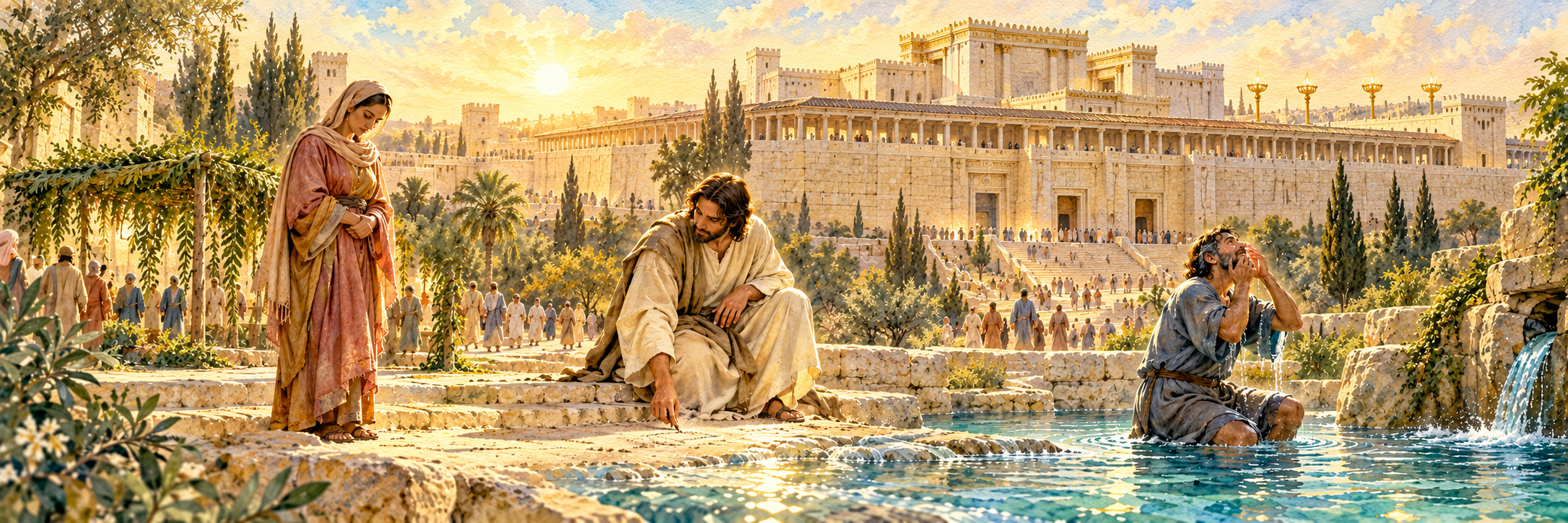
What might we discover in John 7–9 when we hear Yeshua’s words within the festival already surrounding Him? A Shemini Atzeret reflection on Sukkot, living water, restored sight, and the King whose righteous judgments reveal God’s purpose for His creation.
The journey of Teshuva does not end with Yom Kippur.
In fact, Yom Kippur points us somewhere.
It points beyond repentance, beyond confession, beyond judgment, and beyond atonement—to the presence of the King.
That is where Sukkot takes us.
This final week is shorter than our earlier seven-day cycles, bringing us to Yom Kippur. We will move through five themes: the seriousness of sin, God's provision of atonement, the Messiah's saving work, the humility of standing before God, and the continuing life of faithful return.
But Teshuva does not permit us to stand across the street and critique the house.
If we belong to Yeshua, this is our house.
We began with our own location on the road of return. Last week we searched the inner rooms—the desires, defenses, words, idols, and explanations that can hide what is actually happening in the heart.
Now we cross the threshold.
Teshuva comes home.
Around A.D. 160, a bishop in Sardis preached the oldest surviving sermon on the resurrection feast. No eggs. No bunnies. No seasonal sentimentality. Just this:
"I am your freedom. I am the Passover of your salvation. I am the lamb slaughtered for you. I am your ransom. I am your life. I am your light. I am your resurrection. I am your king."
From the beginning, God created humanity to bear His Name and fill the earth with His glory. Rebellion profaned it—from Eden to Babel to Israel’s failure.
Through Yeshua, the perfect Image, that Name is restored and exalted above all. The Gospel announces: God’s original purpose is fulfilled—His dwelling with us forever (Rev 21:3).
This is not merely the conclusion of a counting of the omer (Lev 23:15-16) ; it is the culmination of covenant. The Torah was given at Sinai on this same day, fifty days after Israel’s deliverance from Egypt. And now, the Spirit is given on the same day, fifty days after our Passover Lamb, Yeshua the Messiah, was raised from the dead.
The Genesis account is often read as an origins story. And that it is. As an origins story, it retells the ancient Mesopotamian and Egyptian myths couched in the god stories of the ancients. It corrects those accounts and reveals the One God who has always been the primal cause but whose priority has been let to drift in the memory of His creation. His creation had written its own counterfeit stories. Even yet, these myth stories had echoes of truth that God would now re-reveal to His Israelite prodigies on their way to inherit a promise He had set for them from the beginning.